
Ping Pong & The Pull Of The Spring Door
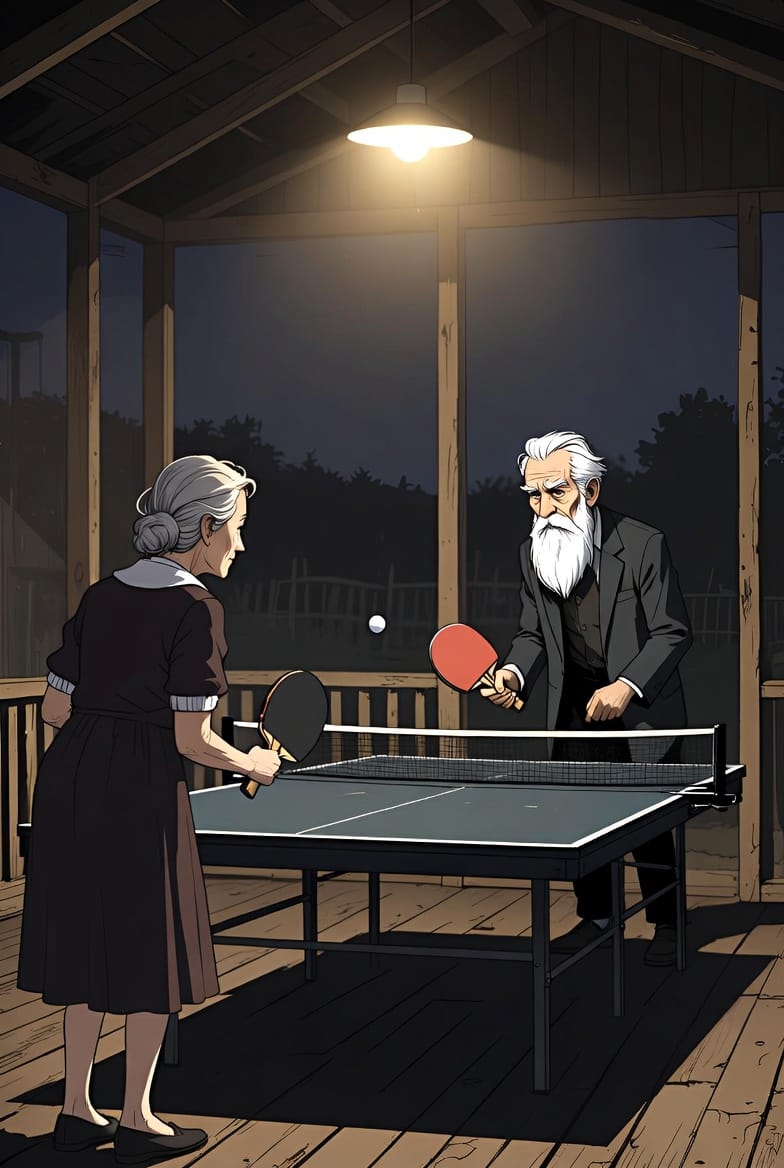
The back patio was never meant to be a sanctuary. It was a poured concrete slab—true enough—framed in humble timber, stapled with wire screen, held together by a door that only closed because the metal spring insisted on it. That faithful, rust-tinted boing-boing that pulled the door back toward “more closed” than “less.”
We played ping-pong out there.
The table wasn’t regulation.
It folded strange, groaned when you leaned on it, and one leg came up short so the whole thing tilted downhill. You didn’t fix it.
That was the Twin Lakes rule:
You don’t fix things that work.
Even if they lean.
Especially if they lean.
And it did work—especially that night.
Outside was dark.
Not city dark.
Country dark.
The kind that makes you swallow and listen.
But the patio’s overhead bulb buzzed warm and yellow, pulling moths into its orbit. That was our sun. That bulb. It lit the table, the screen door, our hands, our sweat, our laughter.
And grandmother.
She was not just there—she was there.
Alive with something electric.
She picked up the paddle like it owed her money.
Held it low. Wrist loose.
That perfect dealer’s grip—as if she were about to flick cards across a blackjack table and teach all of us her philosophy in one motion.
“I’m playing to win,” she said.
And she meant that more than she meant most things.
She wasn’t always well.
Even as a child, you can tell when someone carries a heaviness they don’t name.
The way she walked.
The way her voice wandered off mid-sentence.
The way she sat on the edge of a chair like she wasn’t sure she belonged in it.
But not that night.
That night she stood tall.
Eyes bright.
Paddle ready.
A clean, wild fire beating inside her ribs.
She snapped the ball with the confidence of someone who remembered exactly who she was.
She grinned when she scored.
She talked trash like a sinner at a revival tent—joyful, unashamed, defiant.
Granddaddy stood off to the side, arms folded, nodding slow.
Not surprised—no.
He wore the look of a man witnessing what he’d always known:
that she was built of stronger things than her sickness ever counted on.
We played too—two grandchildren, giggling and competitive and suddenly aware this was not our court.
This was hers.
The screen door snapped behind us every time we scrambled for the runaway ball.
Same rhythm, over and over:
Click of the crooked handle.
Twang of the spring pulling it shut.
Buzz of the yellow light.
Hit.
Miss.
Laugh.
Run.
Twang.
Hit again.
We didn’t know we were making something sacred.
We didn’t know the wire screen would rust.
That the table would warp.
That she’d grow dim again.
But in the warm hum of that night, she was unstoppable.
She laughed from her chest—full, fearless, fierce.
And when the last serve rolled off the edge of the slab and vanished into the dark, she didn’t chase it.
She just turned—breathless, proud.
A queen who had claimed her hour.
“You’ll never beat me,” she said.
“Not when I’m like this.”
And she was right.
I still hear the screen door.
Still see her framed in that yellow light.
Still feel the sting of the serve I never returned.
Because that night was never about ping-pong.
It was about resistance.
It was about a woman who refused to be sick—for one hour.
A woman who burned away her fog long enough to say:
I’m still here.
I still play.
And I still win.
That night, the home place listened.
Not the fields—
the slab,
the screen,
the little storm of laughter spilling into the dark.
And the land remembered.
Because it was about a woman who refused the dark for one hour
and beat it.