
The Origin Of The Middle Man
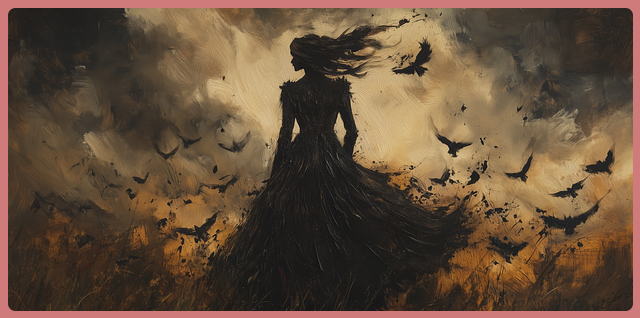
- On the Origin of the Middle Man
There was a time before Witches.
Before their wells.
Before the black tar of human sorrow
was something you could refine.
Before all that,
the world had something far more dangerous:
Collectors.
Not people.
Not spirits.
Not demons.
Collectors.
They tallied what humans could not carry—
regret, guilt, shame, envy, unspoken hatred,
the raw waste products of a soul
trying to live in a body too small
for its own contradictions.
The first Collector broke rank.
He noticed that regret is heavy,
but humans drop it everywhere:
wells, rivers, soil, doorways, thresholds.
He noticed that guilt has texture.
That sorrow has density.
That grief has a market value
if you know where to sell it.
That Collector became the first Middle Man.
He learned to move between Witches and humans
the way merchants once moved between kingdoms:
with both hands open
and one hand closed around the real price.
The Middle Man does not sell sadness.
He sells permission—
the permission to feel it again
in a way that feels familiar,
safe, addictive.
He is the dealer of repetition.
The trafficker of déjà pain.
The Witch refines sorrow.
But the Middle Man distributes the product
like it’s a comfort.
That’s his origin:
a fallen Collector
who realized humans would pay
to suffer the same wound twice.
⸻
- On the Witch’s Siblings
Witches do not come alone.
They are born in sets.
Not twins,
not triplets—
but triads of three distinct functions.
Every Witch has:
1. The Refiner —
the one I saw in the well,
who extracts the poison from the water.
2. The Listener —
who stands near thresholds,
hearing the wishes people whisper
then bending them sideways
into something crooked.
3. The Collector-Shadow —
the silent sibling who gathers
what the other two cannot reach:
the regrets people hide even from themselves.
Only one sibling becomes the Witch proper.
The other two scatter,
taking roles that look human,
sound human,
and sometimes marry human.
But the triad remains.
Where one Witch is,
two more are hidden
in the county,
the town,
or the family line.
This is why the Witch never travels.
She doesn’t have to.
Her siblings are already everywhere.
⸻
- What Happens When a Witch Dies
Witches almost never die.
They can be banished,
bound,
driven off,
sealed—
but true death is rare
because death requires cost.
But when one does die,
the world misbehaves:
• The pines bend backward for a moment.
• The frogs fall silent for a full hour.
• The wells run warm.
• Shadows detach from the bodies that cast them
and wander a few feet before returning.
• Birds refuse to fly over the place for three days.
The Witch does not rot.
Her body becomes soil immediately—
dark, rich, potent.
That soil births a single poisonous bloom
called the Widow’s Torch.
It burns cold.
It doesn’t flicker.
It doesn’t sway in wind.
Grandaddy told me once,
half-asleep in his chair:
“If you ever see a cold flame in daylight,
don’t call me.
Run.”
When a Witch dies,
her well closes itself.
Her siblings feel the rupture.
And someone—
always someone—
is chosen by the land
to replace the function she once held.
The vacancy is dangerous.
A Witch’s death leaves a hunger in the ground.
And sometimes the ground looks at a living person
and says:
“You will do.”
⸻
- Why Grandaddy Refused to Let Me Near That Old Well
He didn’t forbid me
because the well was dangerous.
He forbade me
because the well recognized me.
The first time I walked past it,
the rope creaked
without wind.
The bucket shifted
as if making room.
The pulley whispered
—not words,
but attention.
Grandaddy felt it immediately.
My blood flashed hot.
My ears prickled.
My chest tightened.
He saw it in my face:
I was being weighed
by something deep.
He put his hand on my shoulder
and said:
“Not that one, boy.
Not you.
Not now.”
He didn’t fear the Witch.
He feared the claim.
That well had taken interest in me —
and wells never take interest
without an intention.
I would have heard things
no child should hear.
I would have seen something
rise just below the surface,
something curious about my soul’s shape.
And worse—
I might have spoken back.
Grandaddy wasn’t keeping me safe.
He was keeping me unnoticed.
At least for a little while longer.
Because he knew:
the Witch watches the ones
the wells choose.
He wasn’t afraid
of what I might become.
He was afraid
the well might decide
I already was.