The Witch - And How
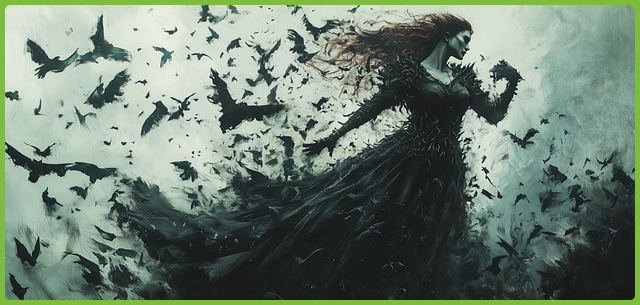
- The Witch’s Contract With the Dark Soil
Before the first well was dug,
before counties were named,
before the first pine bent its back to the wind—
there was a pact.
Not written.
Not spoken.
Exchanged.
The Witch knelt in the lowest place she could find—
a sinkhole swallowing moonlight—
and she made an agreement with the Dark Soil:
“Give me what people bury,
and I will give you what people forget.”
The Soil agreed.
But the Soil is never generous without exacting a price.
From that moment on,
she belonged below the surface.
Not as a prisoner.
Not as a queen.
As a custodian
of everything humans try to push down
and pretend is gone.
The first well was dug directly over her agreement.
Every well after that is an imitation.
That’s why a Witch’s territory
is marked by wells that never run dry—
not because the aquifer is strong,
but because regret is an endless resource.
⸻
- The Witch’s Longest Day (when the tar overflowed)
There was a year—
Grandaddy never told which—
when the Witch went silent for three days.
Not gone.
Not dead.
Just…
overwhelmed.
Regret flooded the well.
Guilt rose like ink.
Shame clotted thick as poured asphalt.
The tar rose faster than she could distill it.
And on the morning of the third day,
black water seeped up the bucket chain,
coated the crank wheel,
stained the stones.
Folks didn’t notice at first.
People rarely do.
They drank their water.
Cooked with it.
Baptized children in it.
And every soul in the county
walked around heavy,
short-tempered,
fever-bright with junk emotions
that weren’t theirs.
Grandaddy recognized it.
Said:
“The well’s breathing wrong.”
The Witch eventually caught up,
but the cost was steep—
her hair went white
in a single night.
That was the year
she stopped tolerating interruptions.
⸻
- Why the Middle Man Fears Running Out of Tar
People think the Middle Man trades in sorrow.
But sorrow is too honest.
Too primal.
Too close to the bone.
What he really deals in is impulse.
The split-second moment between pain
and action.
Regret turns to tar.
Tar turns to pressure.
Pressure becomes the spark
that makes a hand tremble toward:
• a bottle
• a phone call
• an old wound
• a bad choice
• a lie
• a door someone shouldn’t open
• a secret someone shouldn’t tell
The Middle Man bottles the micro-second
between feeling and doing.
He sells the nudge.
And he fears running out
because without tar
people start thinking again.
People start remembering clearly.
People start choosing.
A town with no tar
is a town that wakes up,
and he cannot operate in a waking town.
⸻
- The Witch’s Debt to the Well
The Witch doesn’t live in the well.
She is bound to it.
Each time she distills regret
and separates tar from water,
she owes the well something in return.
The well demands:
• a memory
• a scent
• a night of sleep
• a handful of her own years
• or a fraction of her face
It takes different things each time.
This is why no two Witches look alike for long.
Why they age strangely,
or not at all in human ways.
Why their eyes darken
as if someone keeps dimming a lantern
behind them.
Every bucket drawn
costs her something.
The well does not forget.
The well does not forgive.
The well only keeps adding.
⸻
- What Happens If Someone Refuses the Tar
Almost no one refuses the Middle Man twice.
But on the rare occasion someone does—
someone truly rejects the tar,
rejects the impulse,
rejects the push—
the tar goes searching
for someone weaker.
It slithers.
It seeps.
It waits under doorframes
like a low fog with no scent.
And if it can’t find a mind to lodge in,
it returns to the well
feral, volatile,
half-fermented.
This is the most dangerous form of tar:
unharvested emotion with nowhere to land.
When too much of it returns home,
the Witch hears a sound
like bones being stirred in a metal bucket.
She hates that sound.
All Witches do.
Uncollected tar means
someone escaped her economy.
Someone resisted the system.
Someone said:
No.
Not today.
Not again.
Tar that goes unclaimed
becomes a shadow
that sticks to the walls of the well
and listens for the next generation.