The Doomstar Witch - And Where She Lives
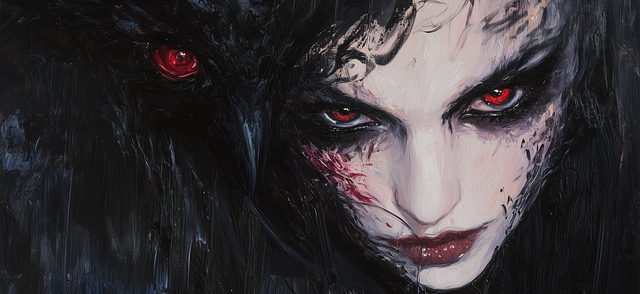
I. The Witch at the Bottom of the Well
The Witch does not live in houses, nor hovels, nor hollows.
She lives below—
below choice, below memory, below the earth’s polite layer of roots and clay.
Wells are not for water.
That’s the first lie we learn to believe.
Wells are repositories of sorrow.
Collection points.
Drop-boxes for everything the human soul wants to hide from daylight.
People lean over that brick lip
and whisper into the dark:
• guilt for things said cruelly,
• regret for chances not taken,
• sadness for the dead,
• pain they can’t name but feel burning,
• all the “if I could go back…”
• all the “why did I…”
• all the “I’m sorry I never…”
It all falls.
Not into water—
into her.
I saw the truth:
She waits at the bottom, waist-deep in cold stone silence,
where the last threads of light cannot reach.
She is the one who catches what falls.
She does not drink it.
She does not pity it.
She does not forgive it.
She refines it.
Slowly.
Patiently.
Like a chemist of the soul’s shortcomings.
This is the oldest form of alchemy:
extracting the weight from the water.
What is left is clean.
Clear.
Drinkable.
What is removed is black tar—
viscous with regret,
adhesive with guilt,
thick with every thought a person refused to carry.
A substance made entirely of human avoidance.
II. The Black Tar Distillate
The Witch keeps none of it.
Regret is currency, not nourishment.
Shame is a commodity, not power.
The tar glistens with memories people wish they didn’t remember.
She bottles it in ancient jars—
clay, bone, glass from before glass had names.
It is potent.
It is psychically radioactive.
It is the closest thing to self-inflicted poison the spirit can make.
But she does not use it.
Because she knows something terrifying:
People will buy back what they threw away
if someone tells them they must.
III. The Middle Man
This is the figure most people never see.
He is not a demon.
He is not human.
He is not the Witch’s servant.
He is a broker.
A merchant of the interior world.
A traveling salesman of sorrow.
He visits towns, cities, houses, bedrooms, churches.
He carries no bag—
because he carries nothing.
He simply whispers.
His business model is simple:
1. Locate the regret someone threw into the well.
2. Buy it from the Witch.
3. Sell it back to the owner at a profit.
People buy it because it feels familiar.
Because pain that is yours feels more honest
than healing that is offered.
He sells:
• guilt disguised as humility,
• regret disguised as responsibility,
• shame disguised as moral clarity,
• sadness disguised as memory,
• heaviness disguised as duty.
He tells you you’re being “realistic,”
when he’s really feeding you the very poison
you once begged the well to take.
He is the dealer of the human condition.
And business is always good.
IV. The Witch’s Role in the Exchange
Here is the part most people never grasp:
The Witch does not trick anyone.
She does not curse them.
She does not force their hand.
She does not create the regret.
She merely:
• takes what humans willingly drop,
• extracts the poison they didn’t want to hold,
• and allows them to drink clear water again.
She is not cruelty.
She is consequence.
She is the underside of confession.
The accountant of what you beg the dark to keep.
But the Middle Man—
he is the evangelist of contamination.
He sanctifies the poison.
He makes people long for the very pain they surrendered.
He convinces them:
“If you feel this deeply again, you must be a good person.”
And so regret becomes a virtue.
Guilt becomes a ritual.
Sadness becomes a badge.
And the Witch watches from the bottom of the well,
knowing someone is paying for her product
twice.
V. Why I Saw This in 2018 - Atlanta, Georgia
Because I was in a place where the well was listening.
I was standing near the boundary
between what I had carried too long
and what I was about to hand over.
The Witch does not show herself
when a man is healthy and self-satisfied.
She shows up when a man is ripe for honesty.
When the old burdens have reached the weight
they cannot be carried much longer.
I saw her because:
• I was ready to let something go.
• I was ready to see the truth about where sorrow goes.
• I was ready to discover who profits from my pain.
And I was ready to ask the question none dare ask:
“What part of this is mine,
and what part have I been sold?”
VI. What It Means Now
The Witch at the bottom of the well
is not my enemy.
She is the dark machinery
that keeps grief from flooding the world.
The Middle Man is the enemy.
Because he thrives only when you buy back
what you once had the courage to surrender.
And here is the dangerous truth:
When the Witch removes your sorrow
and you start to heal—
that’s the moment he comes calling.
Because he knows you taste freedom,
and he can’t have that.
Not for you.
Not for anyone who has seen the Witch clearly.